You don’t have to scroll through fitness content online for long to see a video on Pilates, and the two sides are steadfast in their opinions.
One says Pilates is the most underrated strength tool in fitness, sculpting long, lean muscle without the bulk of a barbell or spiking cortisol.
The other says its benefits are limited; it’s good for how you feel but not for what you're actually building.
We put the question to Sheridan Skye on the latest episode of the Raise the Bar podcast, and her answer is simpler than the debate suggests.
The short answer? Yes, Pilates can count as resistance training and can build muscle and strength, particularly at first. But as you get stronger, continuing to progressively overload the muscles becomes more difficult without introducing heavier resistance.
Meet Sheridan Skye
Sheridan Skye spent fifteen years as a registered nurse, including time in intensive care and a stint as a nursing officer in the Air Force, before she left clinical medicine for strength coaching. She wrote the pre and postnatal training certification currently used by the Australian Institute of Fitness, and she now works specifically with women, helping to clear the blurred lines that exist between what the research actually shows and what makes it into the gym.
Mechanical Tension and Progressive Overload
The best way to get to the base of the discussion is to look at what actually drives muscle growth.
Muscle grows in response to sufficient mechanical tension: the force experienced by a muscle when it works against resistance. And that resistance doesn’t have to come from a barbell.
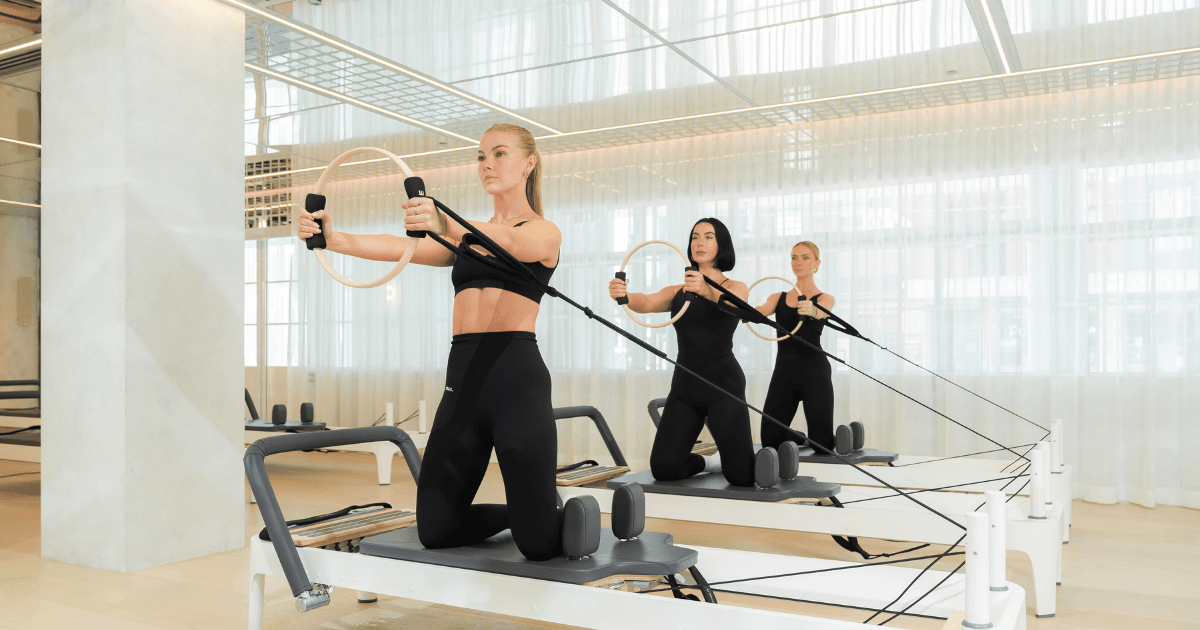
Pilates, Reformer included, provides resistance and can create mechanical tension in the muscle. For someone new to training, that stimulus can absolutely be enough to build muscle and strength.
The limitation comes as your body adapts.
To continue building muscle and strength over time, the training stimulus needs to keep progressing. That can happen through increasing load, reps, range of motion or other variables. This is the principle of progressive overload.
With Pilates, it can become increasingly difficult to keep adding enough resistance to challenge stronger muscles. Traditional weight training makes that progression much simpler: as you get stronger, you can keep adding load.
That’s why the question isn’t really whether Pilates “counts” as resistance training. It does. The more useful question is whether it can continue providing enough stimulus as you become stronger.
We’ve gone deeper into muscle building in our Hypertrophy series here.
What Pilates is also good for
Building muscle and strength isn’t the only reason to train.
Pilates can also:
- Build muscular endurance so your muscles can keep working for longer before fatigue sets in.
- Improve recovery, supporting what you're capable of the next time you're lifting.
- Sharpen control, coordination, and body awareness, skills that carry over to how you move under a barbell
- Wake up smaller stabiliser muscles that often go untouched during bigger compound lifts
These benefits can make Pilates a valuable part of a broader training program, particularly alongside heavier strength training as you become more advanced.
Why do beginners see strength gains from Pilates?
If you're new to Pilates, results can come fast, and this is exactly where a lot of the confusion starts.
An unfamiliar resistance or movement forces the body to adapt. If Pilates presents a meaningful challenge to your muscles, those muscles have a reason to get stronger.
So those early gains are real.
The challenge comes later. Once your muscles have adapted to the resistance, they need a greater stimulus to continue changing. While there are ways to progress Pilates exercises, progressively increasing the resistance can become more difficult than it is with traditional weight training.
Eventually, you may reach a point where the available resistance is no longer enough to drive the same rate of adaptation.
As Sheridan put it, muscle is expensive tissue for the body to build, and it won't build more unless it's given a reason to.
Why "toned" actually means muscle
Part of why this debate never resolves comes down to a single word: tone.
People want to get toned, sculpted, defined. It's the word used constantly in Pilates, and it comes down to two things layered together:
- Enough muscle underneath to give the body shape
- Low enough body fat over the top for that shape to show
Pilates can contribute to building that muscle, particularly when the resistance is sufficiently challenging. But as you become stronger, continuing to add muscle requires the training stimulus to progress too.
This is where heavier resistance training becomes particularly useful. It gives you a straightforward way to keep increasing load as your strength improves.
None of this is an argument for dropping Pilates. If you love it, keep going. It builds muscular endurance, control, coordination, and body awareness, and it's a form of exercise a lot of women stay consistent with, which counts for something on its own.
What Happens If You Skip Heavier Resistance Training
Pilates may count as resistance training, but that doesn't necessarily mean it can provide all the resistance you'll need throughout your training life.
As you get stronger, incorporating heavier resistance gives you more room to progressively overload your muscles and continue building strength and muscle over time.
There’s another important reason to have progressive resistance training in your week: resistance training is one of the most effective tools we have for protecting bone density and muscle mass as we age, both of which decline naturally over time.
Only around 20% of women resistance train, and women are already the ones carrying more of the fracture risk that comes with age. Up to seventy percent of fractures happen in women, and within twelve months of a hip fracture, the death rate can reach thirty percent.
Those numbers can feel like a future problem, something to worry about later. They're not. The muscle and bone behind them get built or lost decades before they ever become relevant.
Listen to the Full episode
This is one piece of a much bigger conversation on women’s health.
In the full episode of Raise the Bar with Sheridan Skye, they also get into cycle syncing and whether the trend actually holds up to scrutiny, what pregnancy and postnatal training should look like, the real story behind PCOS's recent rename to PMOS, and what's actually known, and not known, about peptides and GLP-1s.
Listen on Spotify, Apple Podcasts, and YouTube.
TL;DR
(Too long, didn't read)
- Muscle grows from mechanical tension, the force placed on a fibre under load, which is what lifting weight provides.
- Pilates works mostly through metabolic stress, building endurance, control, and recovery, but not size or strength directly.
- "Toned" means visible muscle under a lower body fat percentage, and building that muscle needs tension, not stress.
- Beginner gains from Pilates are real, but they plateau once the body adapts and the format runs out of ways to add load.
- Reformer works best alongside resistance training, not as a replacement for it.
For now, it’s your turn.
Want this straight to your inbox? YouTube to get practical tools and tips to take your training, health and wellbeing to the next level.
And as always, if you need some support to make that happen, our coaches are ready to help keep that discipline strong. Enquire here.