"How much can I actually earn as a personal trainer?" It’s one of the first questions anyone asks when they’re thinking about making the switch, and it’s a fair one.
The honest answer is: it depends. But that’s not a cop-out. PT income varies more than almost any other profession because it’s shaped by how you work, where you work, how quickly you build your client base, and whether you’re employed or running your own business.
This guide breaks it all down, the realistic numbers at each stage, the factors that move income up or down, and what the ceiling actually looks like for coaches who build their career the right way.
What Does the Average Personal Trainer Earn in Australia?
According to industry data, the median salary for an employed personal trainer in Australia sits somewhere between $50,000 and $65,000 per year. But that figure alone doesn’t tell you much, because “average” covers an enormous range.
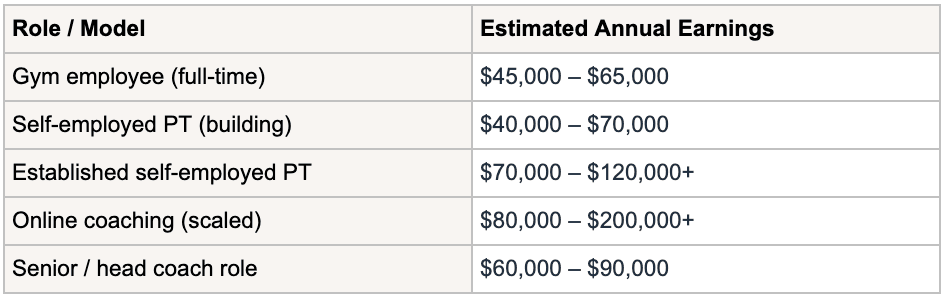
A newly qualified PT working gym floor hours on a casual contract might earn $35,000-$45,000 in their first year. An established self-employed coach with a full client roster can clear $100,000-$120,000. And those who move into online coaching or build a scaled business often go well beyond that.
The better question isn’t “what does the average PT earn?”, it’s “what can I earn if I approach this the right way?”
We’ve got brand new coaches who have been in the industry for a couple of months and clients are willing to pay $120 an hour to work with them. Senior coaches who charge $180 for the hour.
PT earnings by role and model
These figures are indicative and based on industry benchmarks. Individual results vary based on location, experience, niche, and how you build your business.
Employed vs Self-Employed: What’s the Difference?
Employed Personal trainer
Working as an employee at a gym or studio gives you stability, a base salary or hourly rate, set hours, and no business overheads. The trade-off is a lower income ceiling. Most employed PT roles in Australia pay between $45,000 and $65,000, with senior or head coach positions reaching $70,000-$90,000.
For new coaches, starting as an employee is often the right move. You build your skills, your confidence, and your client relationships in a supported environment before taking on the risk of going out on your own.
A limitation here is you can’t earn more by doing more - you’re capped at what you’re paid as a salary.
Self-Employed Personal Trainer
Going self-employed means your income is directly tied to your effort, your reputation, and your ability to retain clients. In the early stages, that can mean earning less than you would as an employee. But the ceiling is significantly higher.
A self-employed PT charging $80-$100 per session and training 25 clients per week is already looking at $100,000+ annually. The coaches who build the strongest businesses tend to combine one-on-one training with semi-private sessions, group programs, or online coaching, which increases revenue without a linear increase in hours.
At OneCoach Academy, we don’t just teach you how to get qualified; we teach you how to build a career. That includes the business fundamentals you need to attract clients, set your rates, and create an income you’re actually proud of.
Does Location Affect How Much You Earn?
Yes, significantly. Sydney and Melbourne command the highest PT rates in Australia, largely because of higher living costs and a deeper market of clients willing to pay premium prices. In Sydney, experienced PTs regularly charge $90-$150 per session. In regional areas, rates typically sit lower, in the $60-$90 range.
That said, location matters less than it used to. Online coaching has levelled the playing field considerably. A coach based in regional Queensland can now run an online business serving clients across the country, or globally, at city rates.
What Factors Have the Biggest Impact on PT Income?
Experience and reputation. Your rates should increase as your track record builds. New coaches need to earn trust first; that’s normal.
Niche and specialisation. Coaches who specialise in a specific area, strength, pre/post-natal, rehab, and sport-specific training, can charge more and attract better-fit clients.
Client retention. Keeping clients long-term is more valuable than constantly finding new ones. The best coaches build relationships, not just programs.
Revenue model. One-on-one sessions are time-capped. Adding semi-private training, online programs, or group coaching multiplies income without multiplying hours.
Where you work. Premium facilities, boutique studios, and private gyms attract clients who expect, and are willing to pay for, higher quality coaching.
The quality of your qualification and training. Coaches who graduate from practical, industry-connected programs tend to hit the ground running rather than spending their first year figuring out basics they should have learned in their course.
How Quickly Can You Start Earning?
Most qualified PTs land their first paid role within weeks of graduating, especially if their course has built-in pathways into the industry. The ramp-up period for self-employed coaches is typically 6-12 months before reaching a sustainable full-time income, though this varies widely.
The coaches who earn the fastest out of the gate tend to share a few things in common: they trained with real clients during their course, they started building their network before they graduated, and they chose a program that connected them with facilities and employment opportunities rather than leaving them to figure it out alone.
OneCoach Academy graduates have direct pathways into coaching roles at One Playground and our wider facility network, so you’re not starting from scratch the day you finish.
Is Personal Training a Financially Viable Career Long Term?
Yes, but it requires treating it like a business, not just a job. The coaches who struggle financially are usually those who focus entirely on their craft without developing the commercial awareness to build a sustainable client base and income.
The coaches who thrive, and there are plenty of them, invest in their development, build genuine relationships with clients, and think strategically about how they structure their work. Many of the most successful PTs in Australia earn well into six figures and do so while maintaining the flexibility and lifestyle that drew them to the industry in the first place.
It’s not a get-rich-quick career. But for people who are serious about it, it’s one of the most rewarding and financially viable paths in the fitness industry.
Want to Build a Coaching Career Worth Having?
The OneCoach Academy Certified Coach program gives you the qualifications, the practical experience, and the industry connections to start earning from day one. The next cohort starts July 2026.
Learn more about the Certified Coach program | Enquire now