
This is the final part of our muscle-building series, where we’re looking at the variables to nail if hypertrophy is your goal.
In Part 1, we covered what actually drives muscle growth, why proximity to failure matters more than rep range, how to structure your weekly volume, and how quickly your. If you haven’t read it, start there.
In Part 2, we covered what happens at the level of the individual session and the individual rep, how to choose and order exercises for maximum stimulus, and how to keep the adaptation coming over months and years. If you missed it, read it here.
Today, we’re finishing with how to structure your workout and how to apply progressive overload.
Let’s jump in!
5. Structure Your Workout for Maximum Gains
Imagine doing 4 sets of leg extensions and then trying to do heavy squats. Your quads are going to be on fire! You’ve reduced how much you can lift and increased injury risk. You don’t want to undermine your best work by doing it when you’re already tired.
This is something that you should factor into how you structure a session.
As fatigue increases through a session, performance decreases, so complexity should decrease too.
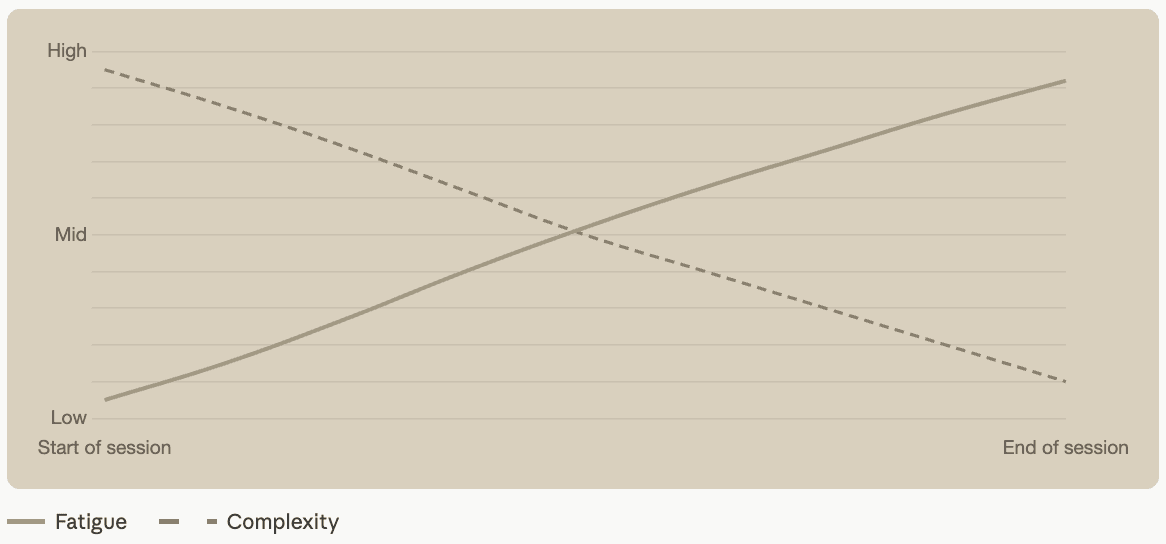
Start with the movements that require the most focus, coordination and load, and work toward exercises that are simpler to execute as you get tired.
In practice, that usually means putting the compound movements (the bigger lifts that recruit more muscles, squats, deadlifts, chest press) at the start of your workout. These are the ones that require the most focus, coordination and load. Then work toward the exercises that are simpler to execute as you get tired: your stretch and isolation movements.
That way, you’ll get more out of each rep and therefore the most out of your workout.
(There is a strategy called pre-fatigue, which intentionally tires out the muscles prior to compound movements. It can have its use, but for most people it’s not necessary!)
Movement Execution
How you execute the movement is as important as which movement you choose. A few things to keep in mind:
- Be willing to reduce the range before you change form. If fatigue is building and form is starting to go, let the range drop slightly rather than compensating with other muscles.
- Don’t let other muscles jump in. When the target muscle gets tired, the body will recruit whatever it can to complete the rep. The set stops being useful for that muscle the moment something else takes over.
Don’t let your rest be too long or too short
You want it short enough that you get your work done and long enough that you get all your work done.
Rest as much as you need to be able to do the next set well, but not at the expense of not getting everything done. For most people, that’s somewhere between 90s and 2 mins for this range.
6. Make sure to Progressively Overload
You can do all of the steps from this post and Part 1 & Part 2 consistently and still plateau if you're not gradually making training harder over time.
Muscle adapts to the demands you place on it. Once that adaptation has occurred, the same stimulus becomes less effective. To keep growing, you need to give the body a reason to continue adapting.
That's what progressive overload is: gradually increasing the training stimulus over time.
Progressive overload is often misunderstood as simply adding weight to the bar every week. But in reality, it is the process of gradually exposing the body to a greater training stimulus over time.
This can be achieved by increasing load, performing more repetitions, completing more sets, improving technique, increasing range of motion, or reducing rest periods.
The Double Progression Method
For most lifters, the most sustainable approach is to increase repetitions first within a prescribed rep range before adding weight. This is known as double progression
For example, if the goal is 4 sets of 6-8 reps, you might:
- Start at 6 reps and work your way up to 8 over subsequent sessions.
- Once you can hit 8 reps with good technique and still finish close to failure, increase the load.
- Drop back to 6 reps and repeat the process.
For example, if you're bench pressing 60kg for 6 reps, your goal might be:
- Week 1: 60kg x 6
- Week 2: 60kg x 7
- Week 3: 60kg x 8
- Week 4: 62.5kg x 6
Then the cycle starts again.
In lower-repetition strength-focused training, load often becomes the primary progression variable because there are fewer opportunities to add reps.
Ultimately, the goal of progressive overload is not to constantly lift heavier weights, but to become capable of producing more force, performing more work, or executing movements more effectively over time. For most people, improving technique first, then increasing reps, then increasing load, and finally increasing volume when necessary, is the most reliable path to long-term progress.
Top Tip: Track your lifts. Weight and reps, every session. A notes app is fine. You can't apply progressive overload if you don't know where you started.
TL;DR
(Too long, didn’t read)
- Compound movements first, isolation last; as fatigue increases, complexity should decrease.
- Reduce range before you let form break down, and don’t let other muscles compensate when the target muscle gets tired.
- Progressive overload is what keeps the adaptation coming. Track your lifts, and when you can hit the top of your rep range comfortably, add load.
Want this straight to your inbox? Sign up to the OneCoach Weekly to get practical tools and tips to take your training, health and wellbeing to the next level.
And as always, if you need some support to make that happen, our coaches are ready to help. Enquire here.