We’re back for part 2 of our muscle-building series!
In Part 1, we covered what actually drives muscle growth, why proximity to failure matters more than rep range and how to structure your weekly volume. If you haven’t read it, start there.
In Part 2, we’re getting down to the level of the individual session, including how to choose the right exercises for maximum muscle growth, and exploring time under tension.
Let’s get stuck back in!
3. Choose the Right Exercises
Now we understand the stimuli that drive muscle growth, what does that actually look like in practice when it comes to choosing your exercises?
Your exercise choice determines which of the three hypertrophy drivers you're prioritising. Most resistance exercises create hypertrophy to some degree, but different types of movement emphasise different stimuli, and understanding that lets you build a session that covers all three deliberately.
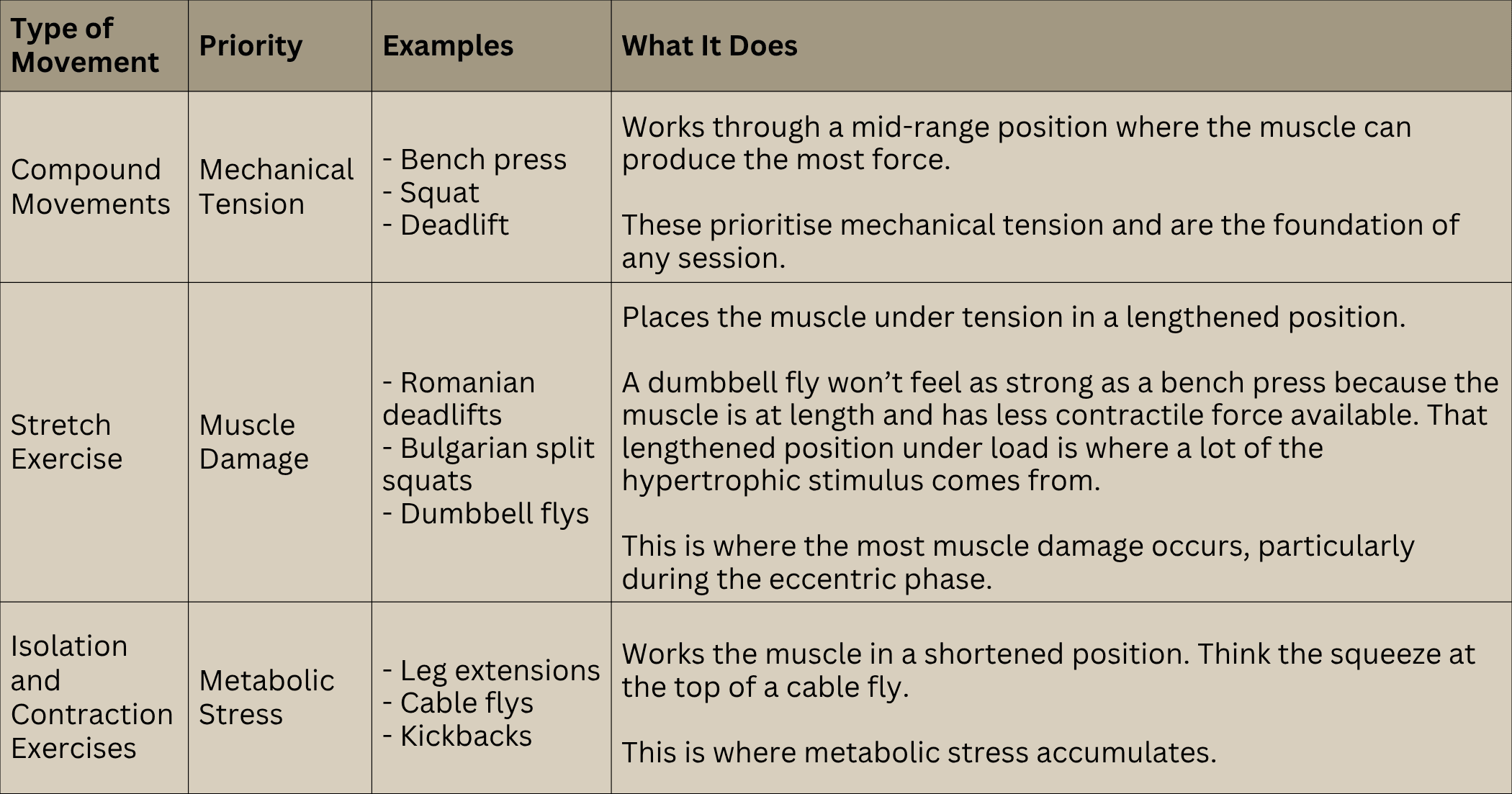
Or more simply put:
- Muscular tension - think heavy
- Muscular damage - think burn
- Muscular stress - think pump
If your focus is purely building muscle
The closer you can get to failure with good form, the stronger the stimulus. The problem with complex movements like a barbell squat or deadlift is that the limiting factor is often coordination and technique rather than the muscle itself; form breaks down before the glute or quad actually reaches failure.
For pure hypertrophy, lower complexity movements give the target muscle the best chance of being the thing that gives out first.
Machines and cables are great for this: they remove the stability and coordination demand so you can focus entirely on loading the muscle
- A leg press will let your quads reach failure faster than a barbell squat.
- A chest press machine will let your pec reach failure faster than a bench press if technique is still developing.
- Single-joint isolation exercises sit at the far end of this, leg extensions, cable flys, lateral raises, where there's almost nothing else involved except the muscle you're trying to work.
If you want a more rounded approach
If you want to build muscle and develop strength, athleticism and movement quality alongside it, the answer is to use all three categories together. Design a session that allows you to hit all three, a really simple way to think about that is to start with a compound exercise, follow up with lower complexity exercises that add volume and hit the muscle from a different angle, and finish with your isolation so you get close to failure.
Here’s what this could look like in practice.
For glutes, a well rounded exercise selection could be:
- Deadlift
- Romanian Deadlifts & Hip Thrusts
- Cable Abduction and Hamstring curls
For chest, that might look like:
- Bench Press
- Incline Shoulder Press & Chest Press Machine
- Cable Flys
We’ll be going into how to structure your workout in more detail in part 3.
If you want an effective (and slightly brutal!) way to complete that hits all 3 stimuli, try the 8-8-16 Triset:
- x8 Barbell Back Squats (mid range > mechanical tension)
- x8 Bulgarian Split Squats (stretch & lengthed position > muscle damage)
- x16 Leg Extension (peak contraction > metabolic stress)
To keep it simple, choose the exercise that allows you to work hard enough to get close to failure.
Range of Motion
There’s a reason you hear people saying try to get your knees below parallel in your squat, or make sure the bar hits your chest in a bench press. That’s to ensure you get enough range of motion.
Moving through a full range puts more length and stretch on the muscle, and that lengthened position under load is where a significant part of the hypertrophic stimulus comes from.
If mobility is limiting your range, it’s worth working on, because a shortened range reduces the stimulus regardless of how hard you’re working.
4. Make sure the set lasts long enough to create adaptation
Time under tension (TUT) is the total amount of time a muscle is actively working during a set. You want to create as much tension as possible, and move the muscle close to fatigue, and the two are connected: if you race through the reps, you’re not giving the muscle enough time to get there.
Slow the reps down. If you’re doing ten squats, you’ll get a lot more from them by slowing down and spending longer on each rep. Aim for 4 to 8 seconds per rep, which is probably slower than you think. A rushed set usually means not enough time under tension to stimulate adaptation.
Emphasise the eccentric. Take it a step further by really exaggerating the lowering phase, the downward part of a squat, the lowering of a chest press, the descent of a hip thrust. Your eccentric strength is actually greater than your concentric strength, meaning you can control more on the way down than you can push on the way up, so use that. Resist the weight rather than letting it drop. The eccentric phase is where the most muscle damage occurs, and muscle damage is a key part of the growth stimulus.
TL;DR
(Too long, didn’t read)
- Match your exercise selection to the driver of hypertrophy you’re targeting: compounds for mechanical tension, stretch exercises for muscle damage, isolation for metabolic stress. A well-structured session uses all three.
- If your focus is purely building muscle, prioritise lower complexity movements and machines that let the target muscle reach failure without form breaking down first.
- If you want a more rounded approach, use all three stimuli together.
- Full range of motion puts the muscle under tension at length, where a lot of the hypertrophic stimulus lives. A shortened range reduces the stimulus regardless of effort.
- Slow the reps down. Aim for 4 to 8 seconds per rep and resist the weight on the way down. The eccentric phase is one of the biggest levers for muscle damage and most people rush through it.
In part 3, we’re covering the final two key factors for contributing to muscle growth: how to structure your workout and progressive overload. Read Part 3 here.
Want this straight to your inbox? Sign up to the OneCoach Weekly to get practical tools and tips to take your training, health and wellbeing to the next level.
And as always, if you need some support to make that happen, our coaches are ready to help. Enquire here.