
Hypertrophy. It’s a word that gets thrown around a lot in gyms and on fitness content, and it simply means muscle growth. If your goal is to build a bigger chest, grow your glutes, add shape and strength, tone up, or just look and feel more like you train, you have a hypertrophy goal.
Muscle building has been at the centre of the fitness industry for decades, and for good reason. The benefits go well beyond aesthetics: improved body composition, greater strength potential, better energy, joint support, resilience, and long-term health outcomes linked to everything from brain function to disease prevention. Resistance training that builds muscle is one of the most impactful things you can do for your body, at any age.
So if building muscle is the goal, here’s what you actually need to know. We’ve split this into three parts - read Part 2 here and Part 3 here.
What makes a muscle grow?
Before we get into the practical stuff, a bit of context on what’s actually happening when a muscle grows. When you understand the mechanism, the decisions you make in the gym start to make more sense. We’ll keep it quick.
The Three Stimuli Needed for Hypertrophy
Most effective training involves a combination of all three.
Muscle Tension
- What it Does: The primary driver of muscle growth. All hypertrophy stimuli require some mechanical tension. Force placed on the muscle when contracting against a load, highest when the muscle is under tension in a stretched position.
- How to Create it: Use heavier loads, train through a full range of motion, choose compound exercises that allow force to be distributed across multiple muscle groups, and controlled movements that increase tension and reduce momentum
Metabolic Stress
- What it Does: Accumulation of fatigue by-products during exercise. The burn you feel during a set of leg extensions.
- How to Create it: Higher rep ranges, isolation exercises (single muscle group), shorter rest periods, continuous muscular tension (no relaxing mid-set) and longer sets taken close to failure
Muscle Damage
- What it Does: Microscopic tears in the muscle tissue, particularly during the lowering (eccentric) phase. The body repairs and rebuilds the tissue, contributing to long-term growth.
- How to Create it: Slow and control the lowering phase of every rep, put muscles through tension at length, include stretch-position exercises (RDLs, split squats, dumbbell flys), and introduce new movements or patterns (highest when the stimulus is unfamiliar)
The first 2 variables to grow your muscles
Understanding the mechanisms is helpful, but what should you actually focus on in the gym?
If you want the biggest return on investment, start with these two variables.
1. Get your proximity to failure right
You’ve probably heard that 8-12 reps is the muscle growth zone. While that's a useful guideline, it's not the whole story; you can build muscle across lots of different rep ranges.
What matters most is your proximity to failure by the end of the set.
You can build muscle at 6 reps or 20, as long as you are taking the muscle close to failure.
(By failure, we mean muscular failure: the point where the muscle physically can’t complete another rep with good form, not just the point where it feels hard.)
The benchmark to use is two reps in reserve (2RIR), meaning you finish a set feeling like you genuinely had only two reps left, not ten. That means you’re close enough to your limit that the muscle was actually challenged, without grinding through with broken form.
As a guide, aim for 6-15 reps with enough load that you’re close to failure at whatever reps you choose.
The reason this range works so well is practical as much as physiological: you’re not spending 30 minutes warming up to maximal loads, you’re not grinding out sets of 30, and it fits into most 40 to 60 minute training slots. It’s convenient, and it works.
A note on progressive rep loading: Start at the bottom of your target rep range, say 8 reps, and work up to 10 over subsequent sessions. Once you can hit 10 comfortably, drop back to 8 and increase the load, then work back up again. That cycle is something we’ll come back to in full in part 3.
2. Get Enough Weekly Volume
The second major factor is volume: the total amount of work performed, often calculated as:
Volume = Sets x Reps x Weight
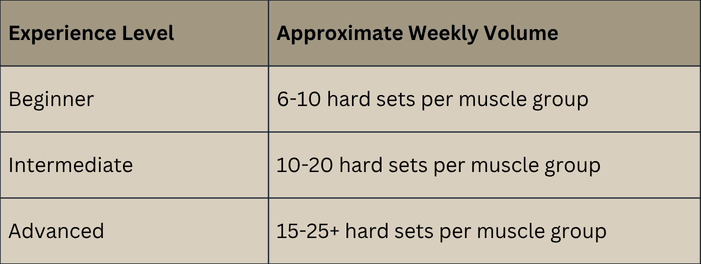
For hypertrophy purposes, however, coaches often use a simpler measure: How many challenging sets are you performing for each muscle group across the week?
The working range for most people is 10 to 20 sets per muscle group per week, with a cap of around 10 sets per muscle group per session. Beyond that, fatigue starts to compromise the quality of what you’re doing.
How to Spread Volume Across The Week
Frequency isn’t so much a driver of hypertrophy, but rather a way to manage the required volume.
Splitting volume across multiple sessions, rather than hitting all your sets in one go, lets you maintain quality with less fatigue per session. Leave at least 48 hours between sessions targeting the same muscle group, as that window is where the adaptation happens.
The fewer sessions you do per week, the more muscle groups you’re fitting into each one, which reduces the volume you can dedicate to any single area. But it’s absolutely possible to get results with fewer sessions if the effort is high enough.
I’ve recently dropped down to 2 strength sessions, 1 conditioning and 1 run. I feel the strongest I’ve felt, but I’m working HARD during those sessions.
As long as the volume is high enough, the best training split for muscle growth is the one that you can stick to! Choose what works best for your goals and your schedule.
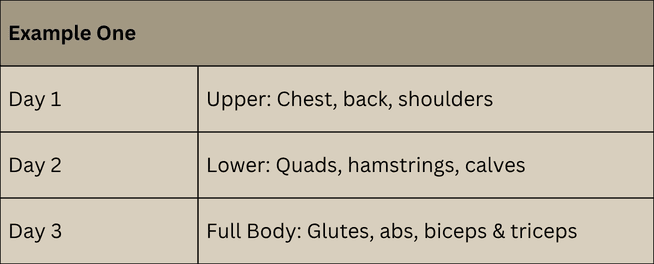
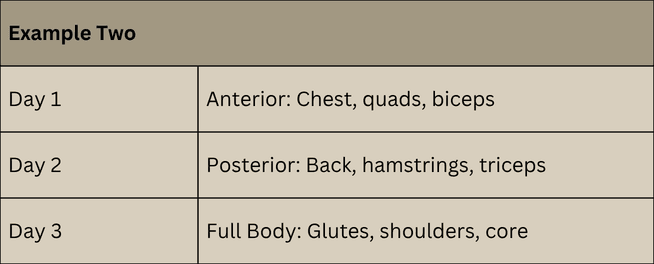
Examples of Training Splits for x3 Per Week
Matt’s here with some recommendations for training hypertrophy three times a week:
Prioritising a Specific Muscle Group
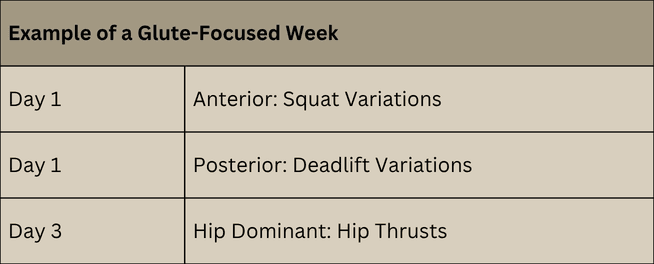
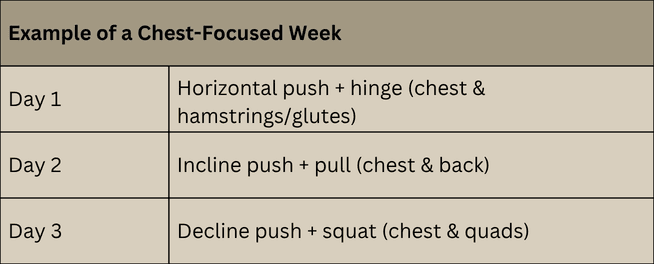
If you really want to prioritise a specific area, and for some people, rather than one long dedicated session, you can break that muscle group up into different actions and make it the primary exercise across multiple sessions in the week.
However, most of the time, this approach isn’t required to see progress. But it can help to see progress in the stubborn or undeveloped area. We suggest making three sessions per muscle group per week the ceiling so you still have time to adapt to the stimulus.
Glute-Focused Week
Chest-Focused Week
TL;DR
(Too long, didn’t read)
- Hypertrophy is driven by three mechanisms: mechanical tension (the primary driver), metabolic stress (the burn), and muscle damage (the eccentric phase). An effective training program uses all three.
- Proximity to failure is more important than rep range. Two reps in reserve (2RIR) is the benchmark.
- You can build muscle anywhere from 6 to 15 reps as long as the effort is there.
- Aim for 10 to 20 sets per muscle group per week, capped at around 10 sets per session.
- As long as you hit your weekly volume and allow time for recovery and adaptation, you can adjust your training split so that it best suits your schedule.
- If you want to prioritise a specific area, train it across multiple sessions in the week rather than one long session dedicated to it.
In part 2, we’re covering the next two key factors that contribute to muscle growth: how to choose the right exercises and time under tension. Read Part 2 here.
Want this straight to your inbox? Sign up to the OneCoach Weekly to get practical tools and tips to take your training, health and wellbeing to the next level.
And as always, if you need some support to make that happen, our coaches are ready to help. Enquire here.