Calories in vs calories out is true, but is it the whole story?
"Calories in vs calories out" is probably the most debated phrase in nutrition.
Some people claim it's the only thing that matters. Others say hormones, food quality and metabolism make calories irrelevant.
The truth sits somewhere in the middle.
Energy balance ultimately determines whether you gain or lose weight, but understanding what influences that balance is what makes fat loss easier, more sustainable and far more successful.
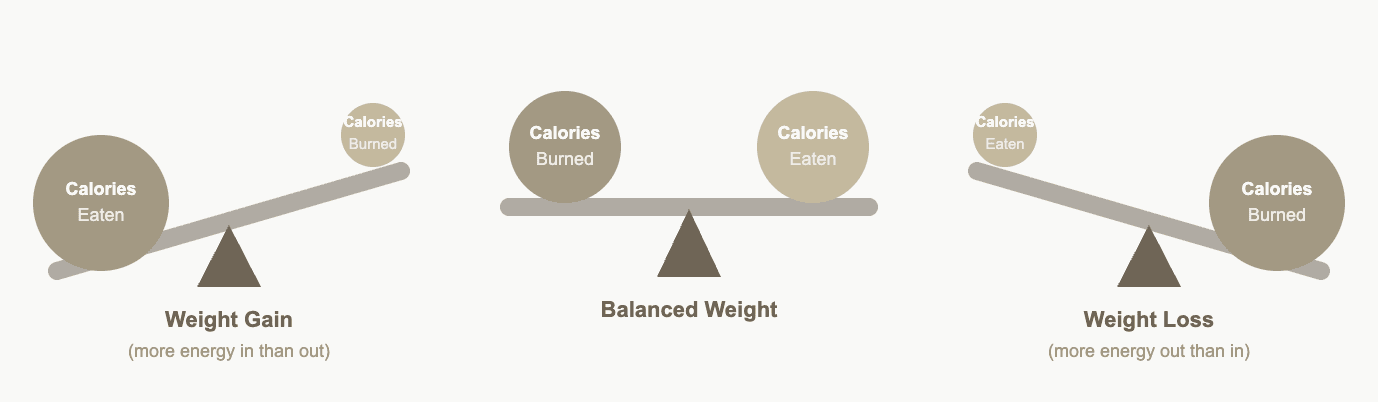
Take a look at the diagram above. It’s easy to predict which way the seesaw will tip.
But what if the seesaw is rusty? What if the wind is pushing from one side? What if gravity suddenly changed?
The fundamental principle wouldn't change, but predicting exactly how the seesaw would behave becomes much harder.
Fat loss works in much the same way. Energy balance is still the governing principle, but many factors influence how easy, or difficult, it is to create and maintain that balance.
What is a Calorie?
A calorie is how much heat is required to raise the temperature of 1 gram of water by 1 degree Celsius. Essentially, it’s a unit of energy, and it's how we measure what goes into the body through food and drink, and what the body uses to function.
Each macronutrient carries a different caloric value:
- Fat: 9 calories per gram
- Carbohydrate: 4 calories per gram
- Protein: 4 calories per gram
Understanding calories is only half the equation. To understand fat loss, we also need to understand where those calories go.
Calories Out: Your TDEE
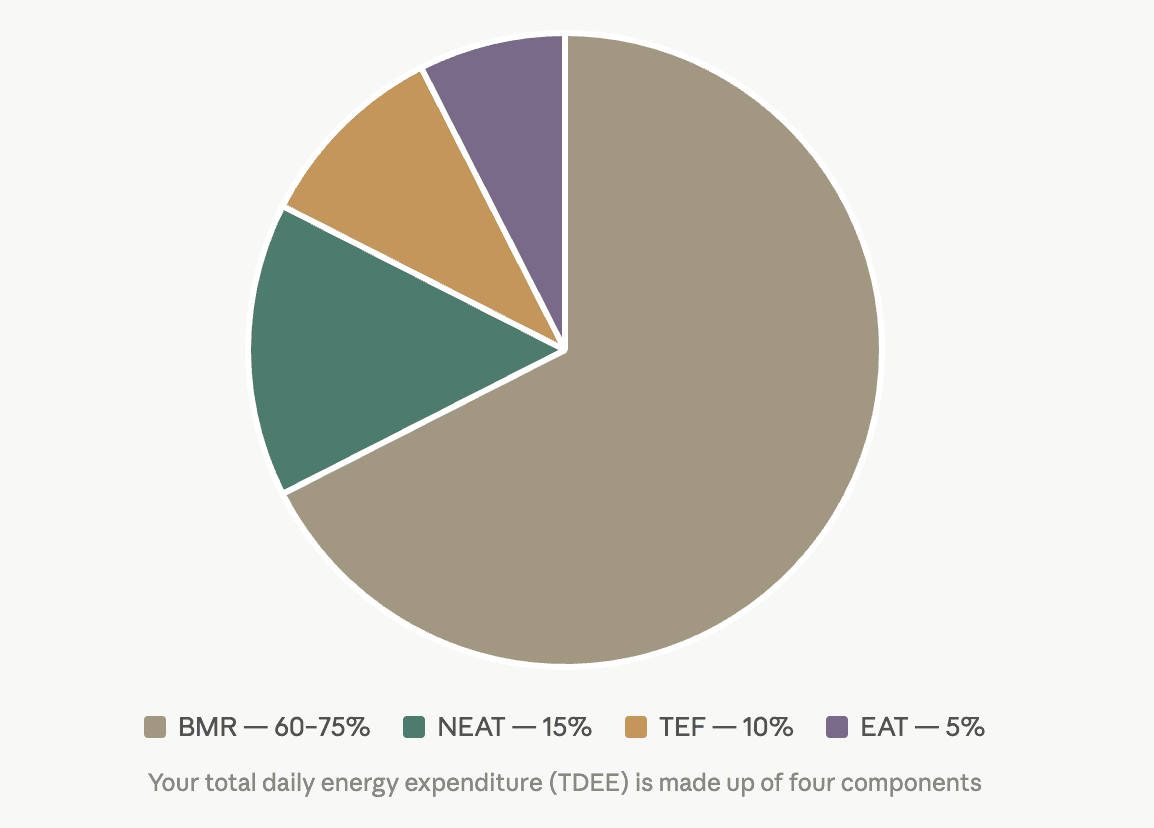
The calories your body burns in a day, your Total Daily Energy Expenditure (TDEE), isn't a single fixed number. It's made up of four components, each of which can shift depending on your circumstances.
BMR (basal metabolic rate) is the energy your body uses simply to stay alive. Breathing, circulating blood and regulating body temperature all require energy, even at complete rest. For most people, BMR accounts for around 60-75% of total daily energy expenditure.
EAT (exercise activity thermogenesis) is the calories burned during training and working out. This tends to be a smaller contribution than people expect, around 5% of TDEE.
NEAT (non-exercise activity thermogenesis) covers all other movements: walking, cooking, cleaning, fidgeting, and taking the stairs. Accounts for around 15% of daily energy expenditure, which is more than most people would guess.
TEF (thermic effect of food) is the energy your body uses to digest, metabolise and store what you've eaten, accounting for roughly 10% of TDEE. It varies by macronutrient: fat has a TEF of 0-3%, carbohydrate 5-10%, and protein 20-30%, meaning your body uses significantly more energy to process protein than anything else.
So if energy balance determines weight change, where does the debate come from?
The answer is that not all foods influence that energy balance in the same way.
Looking Beyond Calories in vs Calories Out
A calorie is a unit of energy, so to say that 1 calorie from a burger and 1 calorie from lettuce are different is incorrect.
What differs is how your body responds to those calories.
What you eat can affect hunger, hormones, metabolism, digestion and satiety in ways that have a real impact on how manageable the equation is in practice.
So if fat loss is your goal, these are the factors worth paying attention to.
Protein
Protein does more work than its calorie count suggests. Its thermic effect is the highest of any macronutrient (20-30% of its calories are used just to digest it), it's the most satiating gram for gram, and it's the primary tool for preserving muscle mass during a deficit, making it a great way to support fat loss.
Fibre and food quality
Take 180 calories of nuts versus 180 calories of a processed snack. Calorically, they're the same. Studies suggest that the body doesn't absorb all of the calories contained in whole nuts, with estimates ranging around 10-20% depending on the type and how they're processed, because their fat is stored in fibrous cell walls that don't fully break down during digestion. Nuts are also high in fibre, which slows digestion and sustains fullness, whereas the processed snack clears quickly, drives more hunger sooner, and is typically engineered to be hyper-palatable in ways that make stopping at 180 calories a challenge.
Your gut microbiome
There's emerging research suggesting the balance of organisms in your gut influences how many calories you actually absorb from food, with some types being more efficient at extracting calories than others. That means two people eating the same thing could have two different metabolic responses.
Metabolic adaptation
When you enter a calorie deficit, your body interprets the reduction in available energy as a potential threat to survival. In response, your body begins making adjustments designed to conserve energy. That means you need to adjust your energy balance over time. It's also why aggressive cuts tend to backfire: the steeper the deficit, the harder the body pushes back.
Hormones and medical factors
For some people, the variables above are compounded by factors outside their direct control. PCOS is one of the more common examples. A key feature of PCOS is insulin resistance, where the body produces more insulin than usual to manage blood sugar.
Chronically elevated insulin promotes fat storage and inhibits the body's ability to access fat for fuel. This can make creating and sustaining an effective calorie deficit considerably more challenging, meaning progress is often slower than predicted by standard calorie calculators. Higher androgen levels common in PCOS also affect fat distribution and how the body responds to a deficit, and the hormonal imbalance tends to drive stronger hunger signals and more pronounced cravings. Progress tends to be slower, and cutting harder typically makes things worse rather than better.
Insulin resistance outside of PCOS, thyroid conditions, and certain medications including some antidepressants can all shift the equation in ways a standard calculator won't reflect. In this situation, it may be better to have a more tailored approach rather than a harder version of something that isn't working.
What to actually focus on
Given all of the above, here's what tends to produce results that last.
1. Keep the calorie deficit moderate. Around 500 calories per day targets roughly 0.5kg of fat loss per week, which is a sustainable rate. A steeper deficit accelerates the adaptive response, increases muscle loss, and makes a rebound more likely. Slow progress is mechanically sound.
2. Prioritise protein. Its satiety advantage, thermic effect and muscle-preserving properties make it the most valuable macronutrient during a cut. It also makes the deficit easier to sustain because you're not fighting hunger on top of everything else.
3. Do resistance training. Building and maintaining lean muscle can modestly increase resting energy expenditure, but its biggest benefit during fat loss is preserving metabolically active tissue while improving body composition.
4. Choose food that works with you. Whole foods, adequate fibre, minimally processed where possible. Not because of any moral hierarchy around food, but because these choices make hunger easier to manage, which makes the deficit easier to maintain.
5. Take sleep and stress seriously. Poor sleep and chronic stress can increase hunger, reduce recovery, lower training performance and make sticking to a calorie deficit significantly harder. They're often overlooked, but they're important parts of the equation.
TL;DR
(Too long, didn't read)
- Calories in vs calories out explains what causes fat loss. Understanding protein, food quality, sleep, stress, hormones and training explains how to make it happen consistently.
- A calorie is a unit of energy, and the balance between what you consume and what you burn determines weight change
- Your total daily energy expenditure (TDEE) is made up of four components: BMR, EAT, NEAT and TEF, all of which can shift
- Food quality affects how manageable the deficit is: protein, fibre and minimally processed food all make it easier to sustain
- Your gut microbiome influences how many calories you actually absorb, making "calories in" an estimate, not a precise input
- When you cut calories, your body adapts: leptin drops, hunger rises, metabolism slows and NEAT decreases, quietly closing the deficit over time
- Hormonal conditions like PCOS, insulin resistance, thyroid issues and certain medications can all shift the equation in ways a calculator won't reflect
- A moderate deficit, adequate protein, resistance training, food quality, sleep and stress management are the levers that actually move the needle long term
Want this straight to your inbox? Sign up to the OneCoach Weekly to get practical tools and tips to take your training, health and wellbeing to the next level.
And as always, if you need some support to make that happen, our coaches are ready to help. Enquire here.